
A Peaceful Land of the Orcs (1.6)
A month and a half had passed since then.
Crossing the boundary from autumn to winter, the Tsengike Mountains south of the Sylvan River in the northernmost reaches of Orcsen were already heavily blanketed with snow.
Rain and sleet began to fall more frequently on the plains, and eventually, full-fledged snowfall arrived, leaving fewer days of clear skies.
The temperature continued to drop.
That night, though it didn’t snow, a bitterly cold and intense rain fell.
The Sylvan River was naturally wide and deep in most parts.
Upstream, there was even a great waterfall, with sheer cliffs extending along both banks. Moreover, there were hardly any bridges crossing this mighty river. For the elves, this river was a kind of holy site, established as a border by myth and tradition. It was a natural fortress, intentionally cutting off access and confining them northward.
In the downstream eastern region, accumulated rocks and river sand formed a shallow ford where crossing was finally possible.
It was there that the last group of Dark Elves escaping from Elfynd—about 1,200 in total—made their crossing.
Gustav Falkenhayn eagerly awaited them in a forested area just slightly south of the opposite bank.
At last, he thought.
The escape of the Dark Elves during this period had been extremely challenging.
The bridges were unusable and were never an option. Elfynd soldiers had established outposts and increased patrols. Perhaps it could have been possible to storm one of these and force their way across once, but the sheer number of escaping Dark Elves made such a method unfeasible. Furthermore, even if they crossed, the other side was Elfynd's southern settlement along the Sylvan River—truly a "dangerous bridge."
In the early stages, negotiations among the clans of Dineluth were hampered by distrust, fear, and disdain toward the Orcs. However, as the looming threat of ethnic cleansing by the Light Elves grew more imminent, the persuasion finally succeeded, allowing larger groups to escape. By then, though, the ford was no longer usable.
Being one of the only points of passage along the great river, it naturally drew the vigilance of the Light Elves. Occasionally, cavalry scouts from Elfynd's regular army began to appear.
Their forces attacked towns, burned villages, and started blocking main roads, tightening their encirclement of the Dark Elves day by day.
Thus, the Dark Elves had no choice but to use upstream crossings for their escape thus far.
In the freezing winter river, whose water level continued to rise, they carried only a meager amount of food, climbed and descended cliffs after much toil, and swam across in small groups to avoid detection.
Even for the Dark Elves—immortal beings unless gravely injured or they themselves chose to end their lives—this was an arduous ordeal. They needed immediate treatment to prevent frostbite and other conditions. Many were already injured from battles with the Light Elves or utterly exhausted. Tragically, more than a few were swept away by the turbulent currents and perished.
Gustav deployed resources from his country's border guard, the 17th Mountain Ranger Division stationed in the nearby Orcsen city of Armband, including their field kitchens, half of their logistical convoys, and all of their field hospitals to support the escapees. However, even his troop deployments had to be carried out cautiously.
Deploying troops openly risked escalating into a border conflict with Elfynd.
Communication points and initial assembly areas on the opposite bank were designated. Kobold soldiers of the Orcsen military who specialized in magic and Dark Elf volunteers exchanged magic signals at minimal output to avoid interception, coordinating to establish the final gathering point near the mountain lodge. Groups of 50 to 100 people would make their escape at a time.
The use of multiple crossing points mitigated some of the challenges, but the hardships remained immense.
Throughout this difficult period, Dineluth remained on the Elfynd side.
While orchestrating the arduous task of getting the Dark Elf escape plan on track, she, along with a small elite team loyal to her and armed with firearms and medicine supplied by Gustav, challenged Elfynd's regular army with guerilla warfare, relying only on scant portable rations and water.
The aim was not full-scale combat but a delaying action—a military strategy to buy time for her people to escape.
Inevitably, her group became the last to escape.
During this time, the Sylvan River's water level continued to rise.
The upstream crossing points eventually became unusable, leaving even the downstream ford at risk.
Expecting the weary and battered escapees to swim across the great river was out of the question.
It was at this moment that one of Gustav’s strategists proposed an idea.
What if they deliberately showed Elfynd a force too small to be considered a major threat?
Elves would likely want to avoid escalating the situation into a border conflict, just as Orcsen did.
They wouldn’t want Orcsen to discover their acts of ethnic cleansing. Such exposure could be perceived as a national security vulnerability.
The ford, considered militarily useless, might prove viable for their crossing.
Gustav immediately adopted the plan.
The scale was delicate, but he organized scout units resembling a company-sized force from the ranger regiments of the mountain division and had them appear sporadically. This would look like a response from Orcsen’s border troops to some disturbance along the border.
The plan succeeded.
The Elfynd cavalry scouts who had been patrolling the ford withdrew.
But the reprieve wouldn’t last long.
A larger force—such as a reconnaissance-in-force unit with infantry or artillery—might be deployed next.
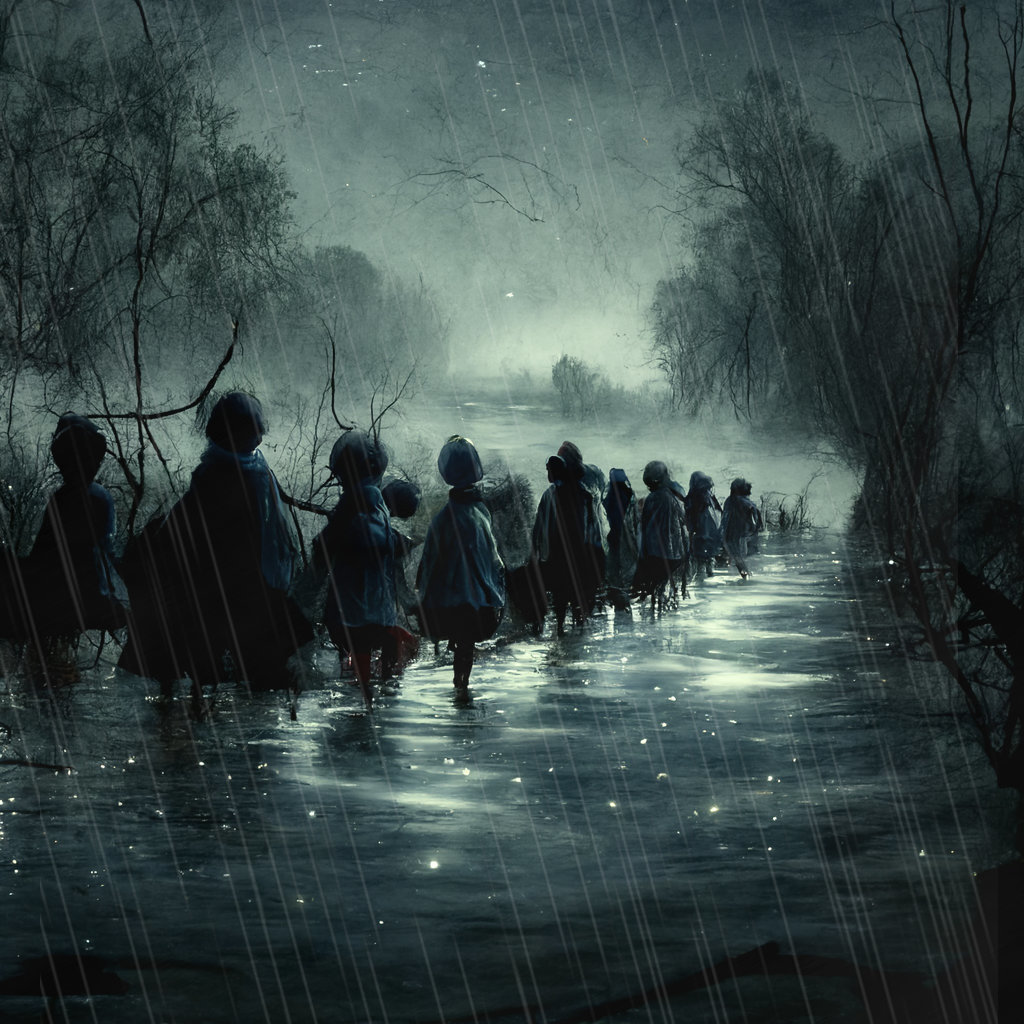
Magic communication was swiftly exchanged between the two banks, and that very night, the final group made their crossing. Fortunately, as if by divine mercy, the rain began to weaken just before the crossing.
Orcs, being nocturnal by origin, had excellent night vision.
Gustav, with his magic prowess, was particularly adept at seeing in the dark.
The same was true for the Dark Elves.
When they used their magic-enhanced vision, their eyes glowed faintly with a reddish phosphorescence.
He saw those faint red glimmers.
Silently, knee-deep in water, yet quickly and as a unified group to prevent stragglers, the Dark Elves crossed.
All wore the hooded coats that could be called their traditional garb, and their faces were painted with the white tribal patterns of their war makeup.
Gustav, in a rare moment for him, felt a chill run down his spine.
---What kind of eyes are those?
It wasn't just the phosphorescence trapped within their cloaks.
If one knew of the Dark Elves' nature beforehand, this sight would not be surprising.
Amidst the rain, they looked straight ahead, without a flinch, their brows motionless.
The eyes of soldiers.
Eyes shaped by countless experiences in battle, witnessing both the deaths of enemies and comrades, surviving, and still maintaining the will to fight.
Moreover, this group carried with them hatred.
Hatred that surpassed even what Dineluth herself harbored a month ago. A blazing hatred, seething only for the Light Elves. Among their ranks were those carrying comrades barely clinging to life on their backs and others clutching numerous charms tied together—likely recovered from fallen comrades.
It resembled the wild fury seen in the eyes of Great Wolves.
The figure at the forefront, having completed the crossing, stood watch until the last of the group finished. Then, as the literal last one, entered the forest that served as the temporary assembly point.
It was unmistakably Dineluth Andariel.
Gustav personally draped a thick blanket over her.
At first, Dineluth didn't seem to realize it was him.
For a while, she looked up at Gustav's towering frame, her eyes blank, appearing lost or dazed, until it seemed she finally understood that it was all over.
"... Orc King."
"Enough, don’t speak. You did well, Dineluth. You truly did well to return."
He rubbed the blanket over her while channeling healing magic infused with waves of mana to envelop her as well.
Half impulsively, he scooped her up in his arms to carry her to the medical unit. The division's supply bakery was baking bread, and the large field kitchen wagon had hot, salted meat soup ready and waiting.
"King... My King... How many managed to escape...?"
In his arms, Dineluth inquired. It was evident she wasn’t asking about just her own troops.
"...… About twelve thousand."
"... I see."
Before the massacres began, the Dark Elves numbered approximately seventy thousand along the borderlands.
Of the remainder, most had died, and the few survivors were taken as serfs to the northern territories.
Because the massacres began as a complete surprise, most of the casualties occurred in the early stages of the conflict.
This rapid and massive death toll in such a short period was attributed to the Elves' unique existence as corporeal beings with spiritual essence. When overwhelmed by profound despair, they lose the will to sustain life.
The Dark Elves, nearly immortal, referred to this phenomenon as "loss-of-glow death," signifying a death where one loses the sparkle of life. This phenomenon likely began around the time Dineluth first crossed the river.
"… Forgive me. If only I had realized it sooner."
Gustav apologized.
Dineluth gently shook her head. Then, taking out the amulet from her collar, she gripped it firmly, adjusted her tone, and spoke resolutely.
"We are deeply grateful for your outstretched hand of salvation. Without it, we, the Dark Elves, would have faced extinction. As promised, from this moment onward, my life, Dineluth Andariel's life, is yours and yours alone. My King."
For a fleeting moment, it was Gustav's turn to fall into silent shock.
Moved by Dineluth's gallantry, he wept quietly, tears of a mighty warrior flowing freely.
While it was an undeniable fact that he had gained an incredibly strong clan as allies, who could serve as ferocious jaws to devour the Light Elves, at least in this moment, such concerns truly didn’t matter.
"Then you and your kin are my people, my comrades, Dineluth. I shall repay your loyalty with my entire being."
What do you think about this chapter?