
How to Start a War (2.2)
Roads. Railways. Bridges. Towns. Ports.
The locations and numbers of garrisons and fortresses. Their structures.
How much food production exists.
All such things can become military intelligence. No, it would be more accurate to say they are military intelligence. All the more so when it concerns foreign nations.
Rottenberger had originally come from the engineering corps, but it wasn’t until he took up this post that he realized he had a natural talent for handling such shadowy tasks.
Due to his background, he had always been able to mentally construct detailed three-dimensional maps since his youth.
Mountain ranges. The undulations of the plains. Their elevation.
The width, length, and winding of rivers, their volume of water.
The length, strength, and structure of bridges———
He could vividly imagine them all.
When he realized that such an ability could also be applied to the intricate assembly of ambiguous things like intelligence, his role as head of the military intelligence agency grew in importance.
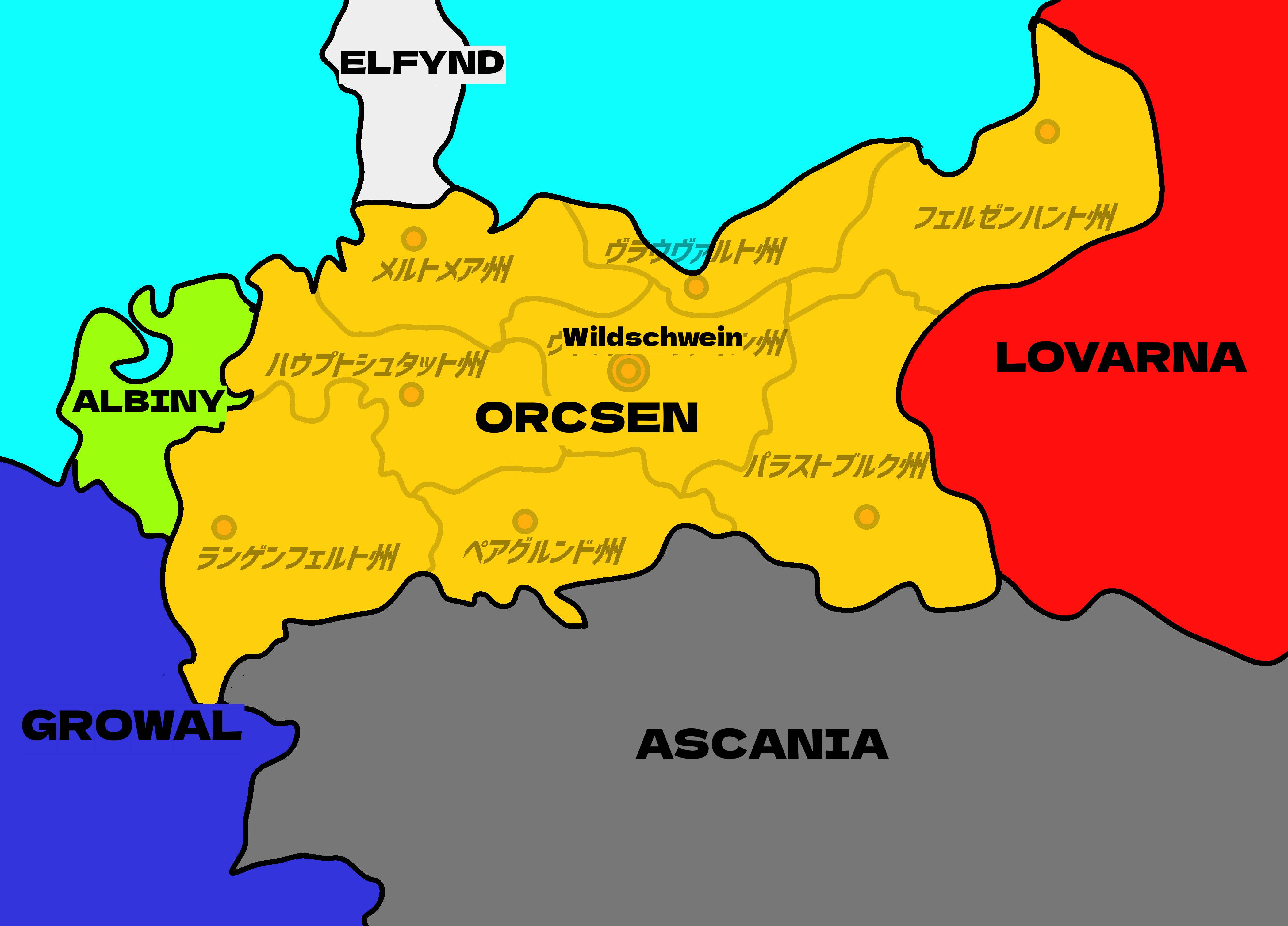
The east:
Lovarna.
The west:
Growal.
Albiny.
Across the sea:
Camelot.
To the south:
Ascania.
Ostarichi.
Even farther south: the Holy Star Church’s Papal Territories, and Etruria.
All these human nations, by virtue of being human nations, could be considered potential enemies of the demonkind nation of Orcsen.
Among them, Growal, Ascania, Ostarichi, and the Papal Territories required particularly high vigilance due to historical reasons.
Centered around military attachés stationed in each region, Rottenberger had constructed a vast intelligence network that spanned nearly all of the Star-Euro Continent———
Now, even within the General Staff Headquarters, his department had become the one receiving the second largest budget and personnel allocation after the Operations Bureau. In other words, more than even the Logistics Bureau (at least in terms of its own departmental budget).
After all, intelligence gathering costs money.
There were even cases where someone on the verge of discovering something big had to be handed a swift, unrecorded payment of around 100,000 lang, prompting the establishment of a slush fund personally authorized by the Chief of Staff.
And yet, there existed exactly one country in all of Star-Euro that Rottenberger could not mentally map out or even imagine.
———Elfynd.
With no diplomatic ties to Orcsen, no exchange of people, and despite being a neighboring nation, it was the most distant country in the world in terms of information.
Even so, it remained Orcsen’s greatest hypothetical enemy———
Attempting to investigate was futile. Not even Orcs, Kobolds, Dwarves, Great Wolves, or Giant Eagles could set foot there.
The information gathered from when those races had been driven off that peninsula was now outdated—old and faded. Not entirely useless, but it had lost value in many areas. The Giant Eagles could still be flown in, but orders had been given to refrain from doing so to avoid excessive provocation.
Only very recently had a single race fled en masse from that nation’s borderlands and sought asylum in Orcsen. That race———the Dark Elves—harbored deep hatred toward their homeland, and from them, Rottenberger was able to gather a trove of fresh intelligence.
Until then, all information about Elfynd had come solely through a single woman—Isabella Farlens.
Why?
Because she alone had been able to handle it—cleverly, secretly, and with an organized structure.
The merchant company led by Isabella was a general trading firm, engaged in imports and exports, finance, and even operated a domestic telegraph and cable manufacturing company, making it the largest conglomerate in Orcsen.
With the vast wealth she accumulated, she invested here, lent money there, acquired one company, accepted another as collateral———
Before long, her influence had extended overseas as well.
Her expansion into the neighboring country of Camelot was especially notable.
She began mainly with finance, and then rapidly infiltrated Camelot’s specialties: shipping, trade, and related insurance companies, ultimately taking on even broader categories of commercial transactions.
Even in the modern age of scientific advancement, major maritime disasters were still not uncommon. When such accidents occurred, the temporary compensation costs borne by Camelot’s shipping and trade companies, as well as the insurance payouts by marine insurance firms, were inevitably massive.
Her company’s role was to hold collateral in advance from these shipping and trade companies and guarantee their immediate payment capabilities, or to underwrite insurance policies for the insurance firms themselves.
It was a savvy business.
All of her clients were wealthy, trustworthy companies. Each transaction involved a large sum, and the profit margins alone were enough to feed a small town for a year.
There were, of course, risks. But she had implemented a clever system to mitigate them.
———A rating system.
The size of the company’s capital. Its financial condition. Owned assets.
Whether it operated in high-accident-prone waters.
The condition and performance of its ships.
The value of its cargo———
She evaluated all of these factors according to specific standards and decided whether to proceed with a transaction.
After all, finance was one of Farlens’s core businesses.
Because the Kobolds could use magic communications, they had been swift in information exchange since ancient times, far beyond human imagination, and were strong in market trading.
For a financial firm, assessing the trustworthiness of a business partner was essential. And Farlens had already accumulated the experience and methods to coolly and relentlessly gather such information.
Nowadays, the ratings assigned by her company had effectively become a benchmark for Camelot’s shipping and trade companies and insurance firms, directly impacting their external credibility and even influencing freight rates.
What do you think about this chapter?