
How to Start a War (1.3)
It was midsummer.
The Star Calendar year 876 was approaching the middle of August.
Even in a season like this, the Orcsen capital of Wildschwein remained extremely comfortable. Some even said it was the best time of year.
The highest temperatures generally stayed below 25°C, while the lows in the mornings and evenings were about 10°C cooler than that. There was no humidity, and of course, one would sweat if moving around, but just slipping into the shade of a tree brought cool relief—a summer country like that.
“So, it’s been that long already. It’s been twenty years since Duke Morington passed away.”
As Orcsen’s King Gustav Falkenhayn gazed into his coffee cup, Claude Maxwell, the Camelot Kingdom’s Minister Plenipotentiary to Orcsen from the Ministry of Foreign Affairs, observed him with great interest, though with the reserved demeanor befitting someone from his country’s ruling class.
He had only recently taken up his post in this country.
He presented his credentials to the King of Orcsen at the beginning of the year.
Originally an officer of the Camelot’s Cavalry Regiment, Maxwell had already gained experience as a diplomat, serving as secretary, consul, and chargé d’affaires, but Orcsen was his first assignment as a full-fledged minister abroad.
For someone with his career background, he was still quite young. That was partly because he switched from being a military officer to a diplomat early, and partly due to his family's noble status.
He had a slender, delicate build, and among the diplomatic corps stationed in home country, he had sometimes been overshadowed by others, so before arriving in Orcsen, he had begun growing a mustache.
That day, he had come to deliver a letter from his home country to the King.
Its contents were a request from the trade authorities to increase exports of elixirs. The King responded with a cheerful and positive reply, and afterward, at the King's invitation, their conversation shifted into a relaxed and friendly chat.
“Duke Morington was a great general. He was certainly strong in attack, but what truly set him apart was his persistence in holding positions and his ability to maintain them at a range no one else could replicate. That was his true value.”
The person the King of Orcsen was speaking of—
The Duke of Morington, Sir Duke Morington, who, sixty years ago during the Dutone War—a massive conflict that engulfed all of the Star-Euro Continent—served as the commander of Camelot’s continental expeditionary force. He defeated Albert Dutone, the war genius born of Growal, and led his homeland to victory.
He had passed away about twenty years ago.
“At that time, we were pushing desperately toward the battlefield from the western border of Orcsen into Growal. We were already in communication with the Duke. But we had fallen far behind. We were nearly out of food.”
“……”
“He must have had his doubts deep down. Perhaps he thought it was a mistake to make a pact with a Demon army. But the Duke, true to our agreement, held his position on the battlefield—at Charleroi, the site of the final decisive battle—and engaged in a fierce clash with Dutone’s continental forces. I still remember it. June 15th, Star Calendar 815. A great day. A day of glory for both your nation and ours.”
The King of Orcsen spoke slowly, fondly reminiscing, his storytelling masterful.
Maxwell found himself forgetting to respond, drawn in completely.
The quality of the King’s low voice was superb.
He described the battlefield from sixty years ago as if he had seen it with his own eyes—no, as if he truly had seen it—and brought the scenes vividly to life.
“Our 125,000 troops arrived at the battlefield that evening. The Dutone army had broken through the Duke’s left flank and begun an assault alongside their seasoned Imperial Guard Corps. But we succeeded in striking their exposed flank. The man next to me, now stationed in the north—Schwerin—was in command of the entire army and shouted—”
Raise the black flags, my sons! We need no prisoners! We need no mercy! Charge!
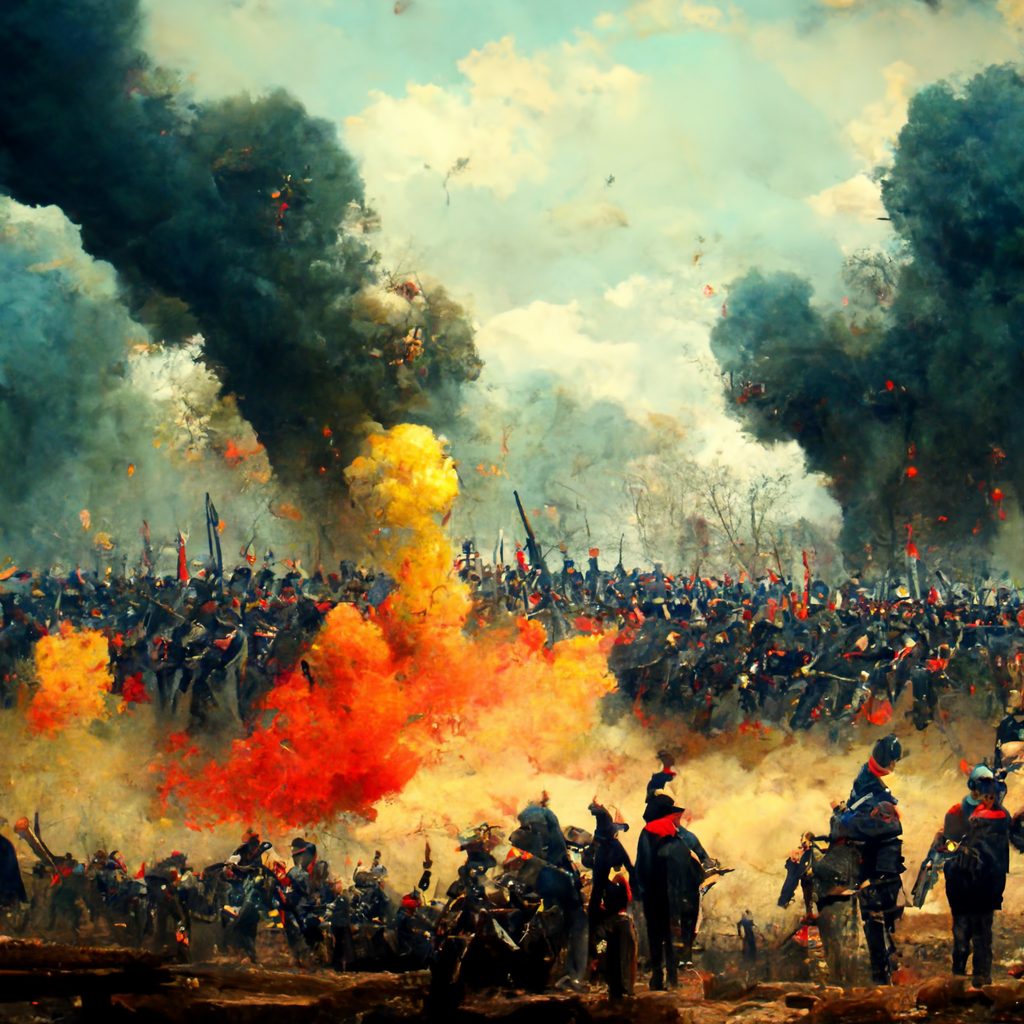
To the sound of the military band playing “Glory of Orcsen,” the Orcsen army, 125,000 strong, raised countless black flags high and charged in unison, muskets already fixed with bayonets like spears, unleashing a simultaneous volley. Bronze cannons roared, the ground trembled, and like a tsunami, they surged forward, crashing into the flank of the Dutone army’s headquarters just as victory seemed within the enemy’s grasp—
Maxwell trembled in excitement.
It was, just as the King said, a day of glory—a moment of triumph—for both Camelot and Orcsen.
And his own grandfather had been there, serving as an officer in the Royal Cavalry Regiment.
“It wasn’t Orcsen who won that battle. It was Duke Morington, who steadfastly held his position and pulled his entire army back ever so slightly at just the right moment. It was his unshakable spirit that won the day. When it was all over and we met again, I told him so myself. ‘You are great. You alone are truly great.’ And he said—”
Gulp.
Maxwell held his breath.
“‘Don’t be foolish, King of Orcsen. It wasn’t I who won. *We* won. You and I, *together*, won.’”
That statement from Duke Morington was indeed recorded.
Word for word, without deviation.
But for those from the Camelot military, it brought a tinge of guilt.
At the final battleground, where the Camelot army had nearly lost, it had been the arrival of the Orcsen army that turned the tide. But it wasn’t something that could be openly proclaimed. That’s why the official biographies of the Duke or the published war histories often included only the first half of that statement.
However, a look at the battlefield records made it unmistakably clear: without the Orcsen army, the Camelot forces could never have won.
What made the Orcsen King’s storytelling so remarkable was that he never once touched on that point. He modestly downplayed his own role while elevating the Duke and the Camelot army to the highest degree.
As for what the Duke himself truly felt about it, that was something no one could now know.
Nevertheless, there was a kind of hint.
After the Dutone War ended, Duke Morington went on to become Commander-in-Chief of the Camelot army, then a peer in the House of Lords, and eventually, Prime Minister.
Though he had been a great hero as a soldier, he was not particularly competent as a politician. Even so, he managed to conclude one historically significant diplomatic treaty.
—The Camelot-Orcsen Amity Trade Treaty.
What do you think about this chapter?