
A Peaceful Land of the Orcs (6.4)
This song is said to have emerged naturally among the Orcs, Dwarves, and Kobolds who were deployed during the Dutone War. At that time, Lowland Orcish had not yet fully spread, so these soldiers would often have to ask each other to repeat what was said, inquire about meanings, and struggle to understand one another while charging through the battlefield.
Because of this, the song contains onomatopoeia and was relatively easy to comprehend. The melody itself was based on a traditional folk song from the Harvest Festival, which was held nationwide in Orcsen every October and was familiar to everyone.
Some recall that it was the most popular song of its time—more so than "The Glory of Orcsen" or "Ah, Our King."
Military songs are interesting in that the ones composed by authorities tend to be solemn, formal, and serious, whereas those that arise naturally among the soldiers themselves are often raw, filled with complaints and emotions, and thus capture the hearts of those who hear them.
The line "For that dear girl" might seem somewhat endearing today, but at the time of the Dutone War, it may have carried a slight touch of sensuality.
Naturally, there was no singing at this military parade, but countless variations of the song had been created by different Orcsen units, and even now, many still favored it.
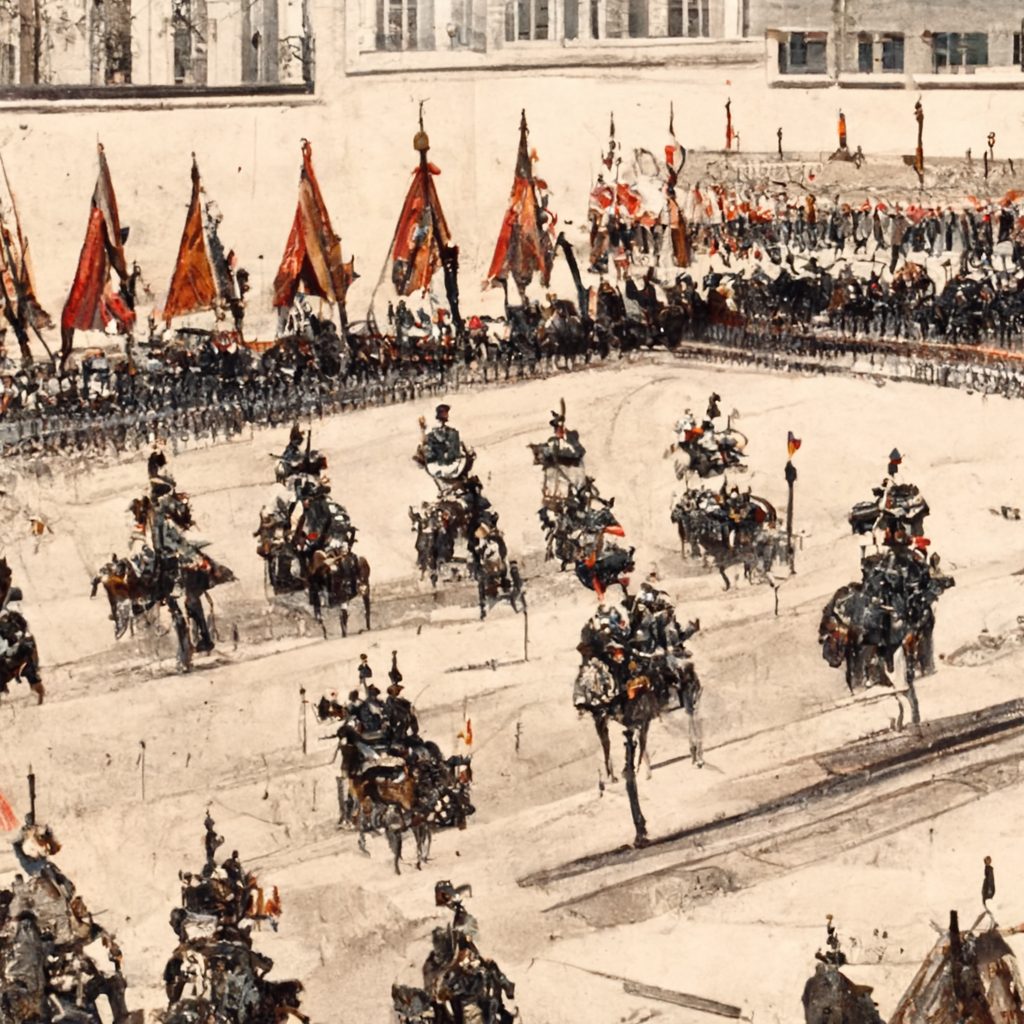
Marching into the parade ground to this lively tune were the artillery units.
There were twelve 57mm mountain guns from two companies of the Jaeger Regiment’s mountain artillery, as well as eighteen 75mm field mountain guns from the brigade’s mountain artillery battalion.
The cannons themselves, along with the limbers and ammunition wagons carrying their shells, were pulled by teams of either four or six horses.
The soldiers either rode on the gun carriages and limbers or mounted the horses pulling them.
The artillery pieces were imposing.
They had a kind of ominous presence—oppressive yet captivating to behold.
This contrast between their formidable appearance and the upbeat tune created a striking, complementary effect.
Some found it peculiar that the Jaeger Regiment’s mountain artillery was organized with twelve guns, but this was a distinct feature of the light infantry branch.
In the broader category of infantry, the grenadiers in Orcsen’s military structure had two 57mm guns per battalion, while each regiment possessed six 75mm field mountain guns as regimental artillery.
However, the mountain jaegers, who frequently operated in mountainous terrain, had battalions composed solely of jaegers, and their artillery was allocated from the regiment as needed.
This meant six mountain guns were assigned for this purpose.
Since the Jaeger Regiment had three battalions, in practice, they were distributed at two per battalion. Additionally, the regiment retained six more mountain guns under direct headquarters control as regimental artillery. Their exclusive use of mountain guns was dictated by the nature of their role.
Essentially, it was just a difference in whether the guns were distributed from the outset or assigned as needed—the total number remained the same. One could liken it to having individual portions of eggs served separately versus all placed in a basket together.
Following them, the brigade’s directly controlled mountain artillery battalion, consisting of eighteen 75mm field mountain guns, represented the Anfaughlia Brigade’s greatest firepower.
Orcsen’s military also had larger artillery formations—field artillery battalions, regiments, and brigades, as well as heavy artillery brigades capable of siege warfare. However, these units were too large and too cumbersome for rapid maneuver warfare, so they were not included in Anfaughlia’s structure.
Moreover, Orcsen’s excellent 75mm field mountain guns were light enough to be used as mountain artillery while possessing performance comparable to other nations' field guns.
Both artillery units wore military uniforms essentially identical to those of the mountain jaeger regiment.
The firearms used by the artillerymen for self-defense were also of the same short rifle type.
Next came the engineer company and the bridging platoon.
Both belonged to the engineer corps, but the former followed closely behind—or sometimes directly into—the front lines to construct fortifications, create obstacles, and handle explosives. The latter specialized in constructing pontoon bridges to support river-crossing operations.
From a military science perspective, they could be categorized as combat engineers and construction engineers.
They marched on foot or in formations accompanied by military wagons carrying their equipment.
The supply wagon corps and medical corps did not participate in full force in the parade.
Part of the reason was simply that their numbers were too great, but there was also a strategic decision not to showcase Orcsen’s entire military structure to foreign observers.
As the various units participating in the parade assembled in the central courtyard, the music changed once again.
The First Grenadier Division’s military band, experienced in performing at ceremonial events, skillfully filled the intervals with drum and fife interludes, expertly maintaining the tempo.
The piece being performed was also making its debut at this ceremony.
It was composed with a deliberately slow tempo to ensure it would not be drowned out by the sound of cavalry hooves, and it incorporated elements of Dark Elf folk music.
It was a newly written brigade song titled simply "Anfaughlia."
Anfaughlia
Anfaughlia
We no longer have the Silver Tree
No tolerance, no mercy left
Hatred is endless, like thirst
With parched jaws, bite down
With bloodstained jaws, tear them apart
Here, the lyrics were not sung, and the melody drifted like the current of a great river. Yet, the words themselves were utterly chilling.
The song was written by a member of the brigade with a talent for poetry.
The phrase "We no longer have the Silver Tree" referenced the Dark Elves’ amulet tradition and symbolized that their homeland was lost.
By now, the song had already spread throughout the brigade.
The Dark Elves naturally loved music and dance.
Every squad had at least one soldier skilled in the lute, flute, or concertina. Some had even carried their beloved instruments with them as they crossed the Sylvan River.
At night, in Walderberg, when food and drink were shared, they initially sang songs from their homeland.
But as the brigade’s name became established, this song and its lyrics naturally emerged.
The more the brigade’s organization solidified, the deeper the song took root.
For them, this song—this song alone—brought back memories of home. It vividly reminded them of the horrific massacres that took place there.
At first, some had found their past too painful to face.
But now, all of them sang it.
It was like a dark passion, a self-inflicted wound salted over and over again—something that others might find unbearable to witness.
But they would all say the same thing:
—We need no sympathy or pity.
That is why.
—Let us devour them. The Light Elves.
The Dark Elves were far from delicate fairies. Their resolve and choices were grim, unwavering, and absolute.
Orcsen’s military leadership had sought to accommodate them by composing an official brigade song, consulting with Dineluth and her people to create a suitable piece for this ceremony.
Yet, what was returned to them—almost immediately—was this song and its lyrics. It left them somewhat taken aback.
When the performance ended—
In the central courtyard, the entire Anfaughlia Brigade stood assembled.
Some were mesmerized.
Some felt a sense of pity.
And some, noticing the dark emotions dwelling in their eyes, shuddered.
It is not officially recorded what thoughts went through King Gustav Falkenhayn’s mind.
But at the very least, Dineluth Andariel felt she understood.
Before giving his address, the King met her gaze and gave a small nod.
What do you think about this chapter?