
A Peaceful Land of the Orcs (4.8)
Technically, it was an extension of black powder, using rye husks instead of wood materials as its raw ingredient.
When this powder was used, though only slightly different, the explosion burned with resilience rather than occurring instantaneously.
A longer explosion meant that more kinetic energy was transferred to the bullet.
This extended the shooting range.
Moreover, the shape of the bullet at the tip of the metal cartridge filled with this brown powder had been revised.
Until then, bullets resembled the shape of acorns.
By making them sharper and pointed, the flight performance was improved, further increasing the range. In Orcsen, they are called pointed bullets.
The shape at the bottom of the bullet, where the explosive force is absorbed, was also revised, from a flat design to a tapered one.
Inside the gun barrel—specifically the bore, referred to technically as the "rifling"—grooves were cut to impart rotational motion to the bullet, further increasing its range.
This rifling technique was not new, but by tapering the bullet's base, the bullet not only gained rotational force but also improved flight performance when fired, enhancing the range.
This shape, resembling the stern of a ship, earned it the nickname "stern bullet."
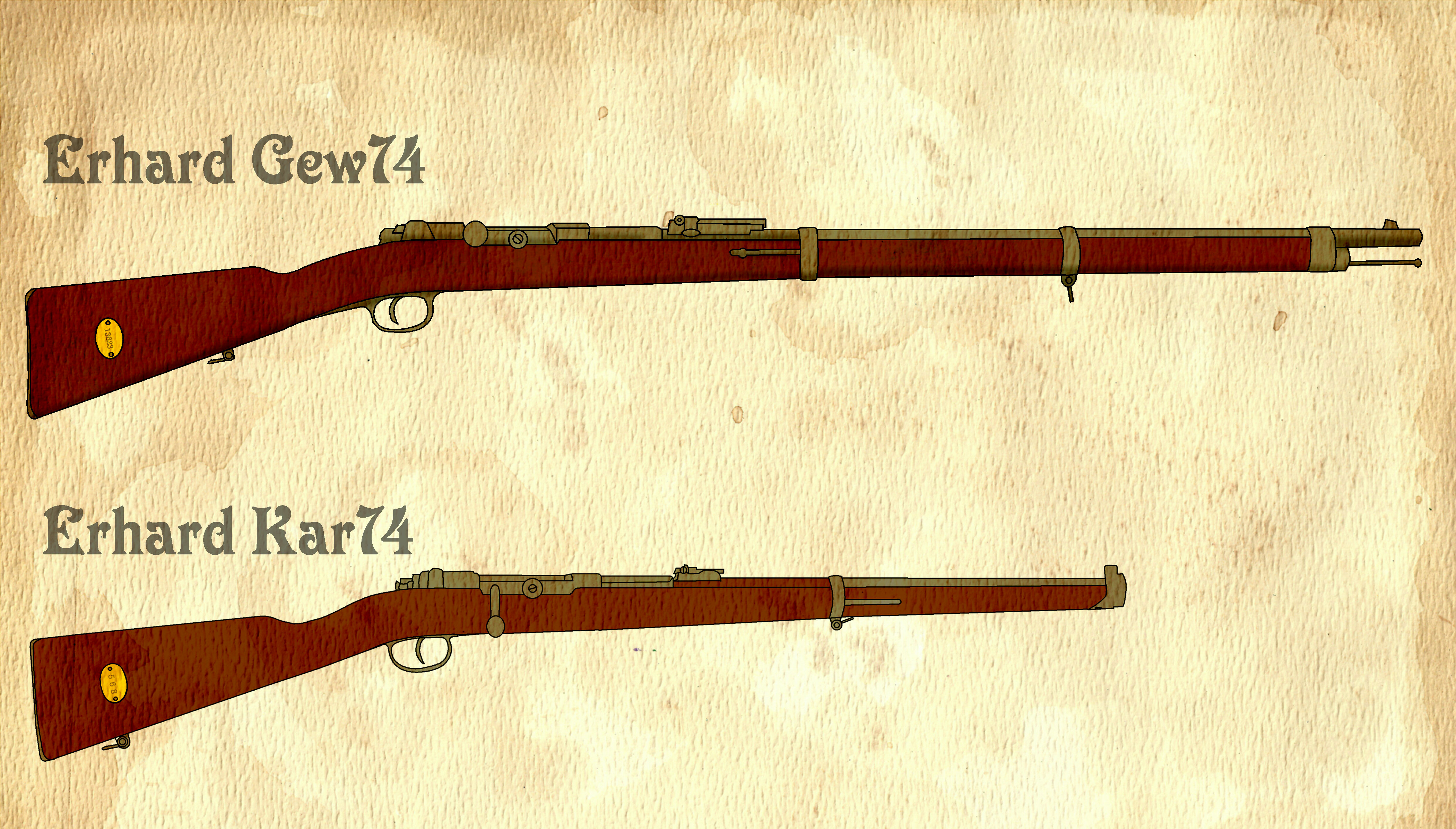
All these improvements combined existing techniques into one firearm: the Gew74 rifle. It could be described as a revolutionary yet well-rounded weapon.
As for the powder, engineers reportedly aimed for something different, but—
In any case, it was a shocking weapon for the likes of Dineluth.
Orcsen produced 120,000 of these annually using two domestic arsenals, rapidly replacing the standard rifles of the time.
Shorter versions of the rifle were made for cavalry, artillery, and engineers.
There was once a discussion about how, in terms of range, a long-barreled infantry rifle had an advantage over a shorter-barreled cavalry rifle, putting the latter at a disadvantage during skirmishes.
That comparison only applied to firearms with similar performance levels.
The cavalry rifle version of the Gew74, the Kar74, extended the ideal engagement range to 800 meters due to the improved performance of the base rifle.
This meant it could effectively compete with infantry rifles from other nations.
It was no wonder this left people stunned, astonished, and in awe.
The Blue Army units advanced southward, targeting the Red Army's defensive line.
They had accurately pinpointed the position, troop strength, and deployment. Given the strategic importance of the triple intersection, there was no reason for them not to act.
Moreover, the opposing side was aware that aerial reconnaissance had detected them.
The Blue Army's commander decided to act before the Red Army could respond, advancing and addressing the situation.
The Blue Army also deployed scouts, main units, and higher-level forces.
However, their movements were even more refined this time.
Their forces were intentionally thin. The location was across a river.
Naturally, the Red Army detected the enemy in front through magical sensing and visual confirmation, and they began firing. Their response was swift. The Red Army's frontline commander wisely combined magic detection with traditional methods such as high ground surveillance and sentinels for distant observation.
The distance between the two armies was 1,500 meters.
Although slightly farther than the ideal engagement range, the Blue Army, with only a battalion-sized force advancing, forced the Red Army to open fire. Even so, it was within the effective range of the Gew74. Additionally, they had artillery.
Commands were issued.
The skirmish line, composed of grenadiers, began firing.
First, controlled volleys.
Grenadiers loaded their rifles, aimed, and fired collectively at the command of their officer, in company-level units.
Gunfire and white smoke rose simultaneously.
The white smoke, even with the brown powder cartridges, looked no different from that of black powder.
It spread widely but quickly cleared with a gust of wind.
However, the thick smell of gunpowder lingered.
The Orcish soldiers, with a mix of love and hate, described it as "a devilish scent surpassing any woman."
A rain of bullets spanned 800 meters in width. If these were live rounds, any standing enemy would likely have been entirely struck down.
This powerful barrage was executed twice.
Next, they transitioned to independent firing.
Soldiers loaded and aimed, firing as soon as they were ready without waiting for commands.
With an entire regiment (excluding reserves) engaging in full-force firing, even with blank rounds, the effect was overwhelming.
The gunfire and accompanying white smoke.
The deafening noise.
It engulfed everything. Near the training grounds, villagers might have even been covering their ears.
"......"
Dineluth furrowed her brow, silently observing.
"That's fast... at this rate..."
Iavasril muttered, barely audible over the overwhelming noise that seemed to dominate the entire training ground.
She was commenting on the grenadiers' firing speed.
The rifles, with a single-shot bolt-action mechanism, had impressive performance.
However, firing at such a rapid pace would quickly deplete their carried ammunition—each soldier's personal supply would soon run out. While it might be an exaggeration to say they'd use it all, most of it would indeed be consumed, leaving the infantry's greatest weapon—the rifle—without firepower.
To replenish this, the process of delivering reserve ammunition from military wagons stationed with the reserves would need to begin. Yet for Orcsen's army—a force known for its meticulous logistics—there seemed to be no such movement.
What do you think about this chapter?