A Peaceful Land of the Orcs (1.3)
“---I see. How cruel... how terribly cruel...”
These words were heartfelt, coming straight from within. Gustav truly meant them.
Seated in a well-cushioned chair in the lodge’s resting area, Gustav finally managed to express something resembling a reaction in front of Dineluth, who, having resolved to confide in him, had shared all the details after he saved her people.
He had invited her to sit as well.
Gustav had no inclination to leave someone standing, especially a proud member of another race.
Freshly brewed, rich, hot coffee sat on the side table, though neither felt inclined to touch it.
As rumors indicated, the Elves of Elfynd on the Belleriant Peninsula, north of the Sylvan River, appeared to have descended into a civil war.
Or rather, it was uncertain if it could even be called a civil war.
The Light Elves, with their fair skin and the kind of appearance people usually associated with Elves, made up over ninety-nine percent of the population and were systematically exterminating the Dark Elves.
Gustav searched his memory and knowledge for a word suitable for this situation.
He recalled the perfect wording.
—Ethnic cleansing.
To him, Elves and Dark Elves didn’t seem all that different.
Even Dineluth, sitting before him, didn’t match the “Dark” stereotype as outsiders imagined. Her skin had a healthy tan, like ripe wheat—a dark brown, perhaps, but not black.
Elves and Dark Elves were both tall, though typically, the former were slender and fairy-like, while the latter possessed a wild, lithe strength in their limbs.
But, as with many ethnic conflicts, no matter how similar two groups may seem to an outsider, within their own minds, they were irreconcilably different.
The true origins of their divergence as races were no longer clear, even to them. Legends spoke of a rain of stars at the dawn of this world’s creation, seen by the “Light Elves” and not by the “Dark Elves.” The ancient words they used for each other—“Light Elves” and “Dark Elves”—stemmed from this.
To Gustav, it seemed unlikely that such mythical events had even altered skin color; it was probably mere legend.
Regardless, the two races had lived in the same region and the same country, yet in separate areas and with distinct cultures.
The Dark Elves inhabited the mountain region along the northern banks of the Sylvan River, a natural border marked by mythology, relying on grazing, dairy, and hunting.
The Light Elves, by contrast, resided further north, from the central to northern parts of the Belleriant Peninsula. They cherished forests and lakes, practiced agriculture, and engaged in song, music, wisdom, wordplay, and literature.
The Elves had always harbored a faint disdain, almost akin to discrimination, towards the Dark Elves, though as long as there were external wars to fight, things went well enough.
They cooperated, with Light Elves formulating strategies and Dark Elf clans serving as mighty warriors guarding the borders, securing victories for their homeland.
However, with a hundred years of relative peace following the end of external wars, unfavorable changes began to surface in the longstanding dynamic between the two groups.
Economic competition and the influx of human technology and science brought divisions based on wealth and adaptation to the new era, which in this country ended up aligning perfectly along the Light and Dark Elf divide.
All that was left was to wait for a “spark” to ignite the fuse.
About a year ago, a Dark Elf, previously a trusted aide to the Elfynd royal family, was accused of treason and ousted. The trial concluded without incident, but rumors said other aides assassinated him. Supposedly, it had been an ugly political feud born of jealousy and personal grudges.
But this incident was the spark that ignited the “Dark Elf Hunt.”
The elegant, fairy-like Elves had transformed into prejudiced bigots and slaughterers, filled with hate for their kin of a different race.
Now, the Dark Elves, long tenuous in status, were being driven from the heart of the nation to its borders, from life to near extinction.
Ambushed and killed.
Shot.
Hanged.
Buried alive in massive pits.
Those who despaired of survival chose death for themselves.
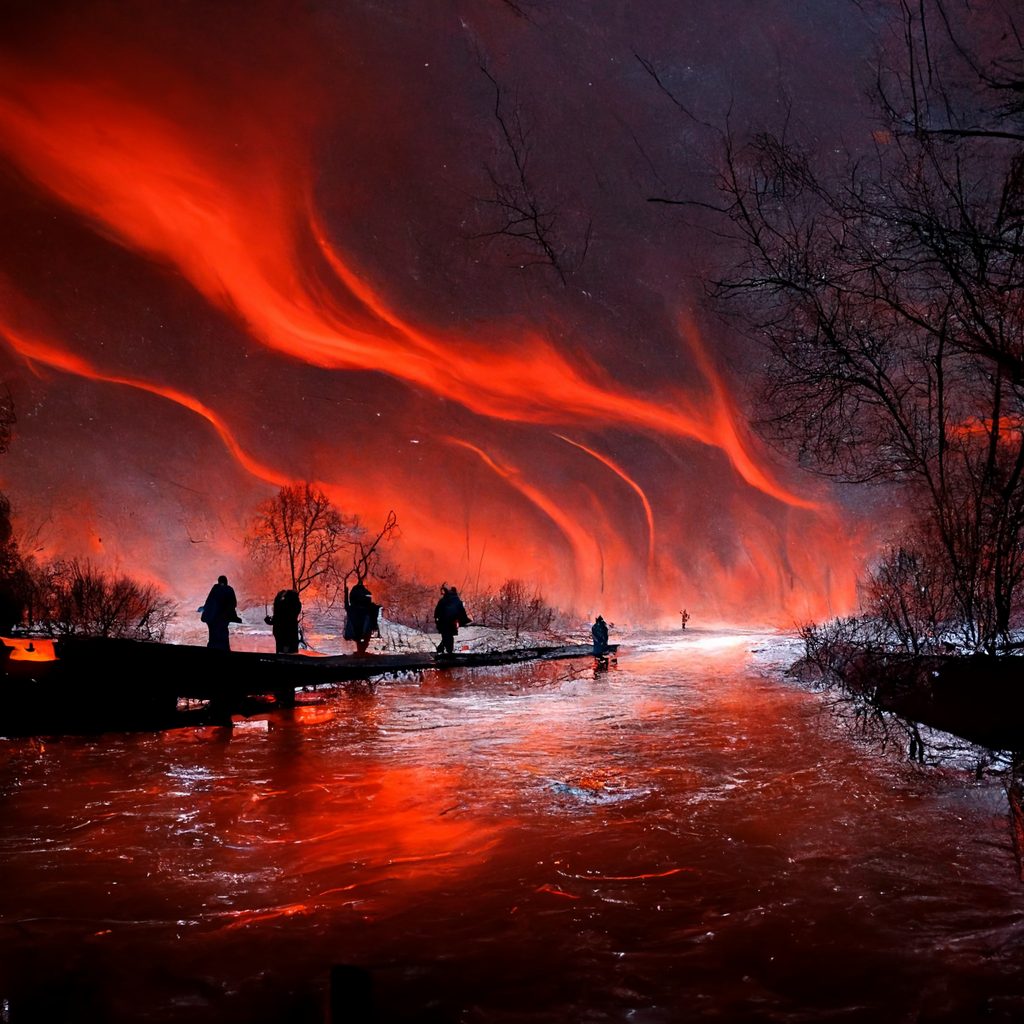
In Dineluth’s clan’s case, one day their village was suddenly razed by Elfynd’s regular army.
She said many died.
Dineluth herself survived because she was out hunting; though she bravely stood her ground, the odds were overwhelmingly against her.
In the end, she had no choice but to flee across the Sylvan River with the other survivors, hoping to reconnect with other Dark Elf clans on the far side.
That was her story.
… Indirectly, I am complicit in this...
Gustav turned over this slightly twisted thought in his mind.
In the past, Elfynd’s major external adversary had been them—the Orcs.
After much time, he managed to unify the Orc regions, hold off invasions, establish clear laws, foster industry, and pursue internal growth, engaging in trade—and sometimes conflict—with human nations.
To think that would drive the Elven races into this position...
“So... what do you plan to do now?”
“I’ll return. That’s my plan.”
After finishing her explanation, Dineluth stated her intention firmly.
Her strong, well-shaped eyebrows, brown eyes, the same shade as her chestnut hair—all conveyed a steadfast resolve. Her full lips were pressed into a determined line. Her low voice, hinting at her homeland, her words tinged with earthy wildness, and her imposing figure—more robust than what one would expect of an Elf—all radiated a scorching, vengeful intensity.
“I’ll help my clan, join hands with other clans, and resist to the best of our ability.”
“I see...”
He had no intention of stopping her.
Nor did he have the right to intervene.
But...
—She cannot win.
What do you think about this chapter?